Mass Protest in Skopje Over Language Rights in Higher Education
Albanian students demand enforcement of legal provisions for native-language exams
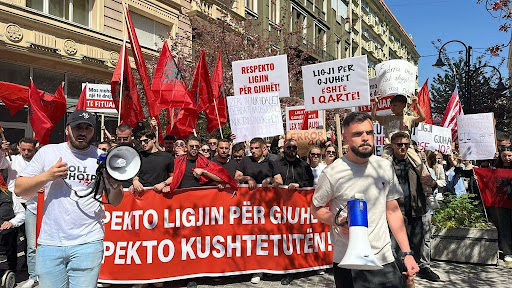
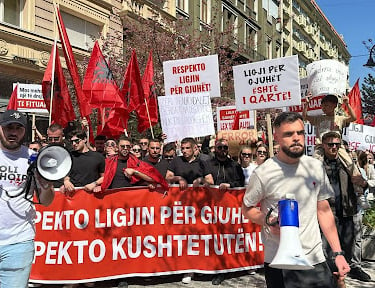
A large demonstration unfolded in Skopje as Albanian students from the Faculty of Law organized a coordinated march to demand enforcement of their legal right to take exams in their native language (e drejta ligjore për të dhënë provime në gjuhën amtare) and equal treatment within the higher education system. The protest lasted approximately two hours and brought together thousands of participants who moved through central boulevards, highlighting what they described as a persistent gap between existing legislation (legjislacioni ekzistues) and its implementation in practice.
The gathering was centered near the Ministry of Justice, where students established a speaking platform to address what they characterized as institutional inaction (mosveprimi institucional) and lack of accountability. During the event, demonstrators publicly expressed dissatisfaction with authorities and called for political responsibility (përgjegjësi politike), including the resignation of senior officials from institutions responsible for enforcing language rights in education. The protest maintained a structured format, with speeches and coordinated messaging directed at government bodies.
Participants emphasized that the issue directly affects their academic and professional prospects. Students enrolled in Albanian-language programs reported that they are still required to complete final examinations in Macedonian (provime përfundimtare në maqedonisht), which they described as a discriminatory requirement that undermines equal access to opportunities. They argued that this practice creates a systemic barrier to career development (pengesa sistematike për zhvillimin e karrierës) and contradicts legal guarantees intended to protect linguistic rights.
The demonstration also carried visible national symbolism. Protesters displayed banners and red-and-black flags, underscoring the importance of language for identity (rëndësia e gjuhës për identitetin) and its role in shaping both academic trajectories and future employment. The presence of these symbols reflected a broader concern that language rights are tied not only to education policy but also to cultural recognition (njohja kulturore) within state institutions.
Despite the scale of the protest, authorities had not issued an official response at the time of reporting. The absence of immediate engagement from government representatives has contributed to continued uncertainty regarding whether the students’ demands will lead to policy changes. The situation highlights an ongoing tension between formal legal provisions (dispozitat ligjore formale) and their practical enforcement in public institutions.
Language rights for ethnic communities in North Macedonia have been a subject of legislative development over the past decades, particularly following frameworks designed to ensure broader inclusion. However, the students’ claims suggest that implementation remains inconsistent in specific sectors such as higher education. The current protest reflects a concrete example of how legal guarantees (garancitë ligjore) may not always translate into everyday institutional practice, especially in contexts involving standardized academic procedures.
The protest in Skopje represents one of the most visible recent mobilizations focused on linguistic equality in the education system. By framing their demands around enforceable rights rather than new legislation, the students positioned their movement as a call for compliance with already established norms. Their central argument remains focused on eliminating what they describe as a discriminatory academic requirement (kërkesë akademike diskriminuese) and ensuring that all students can complete their studies under equal conditions.
Albanian students protest in Skopje to defend their language.
Send us your suggestions to: pr@albanian-institute.com
Come visit Albania!
© Copyright 2026 Albanian Institute
Learn the official language of Albania and Kosovo in 30 days thanks to our complete Grammar, Vocabulary and Culture courses. Start speaking Albanian today!