Albania Opposition Protest Deepens Political Crisis
Violent clashes in Tirana reflect growing tensions over governance, corruption, and elections
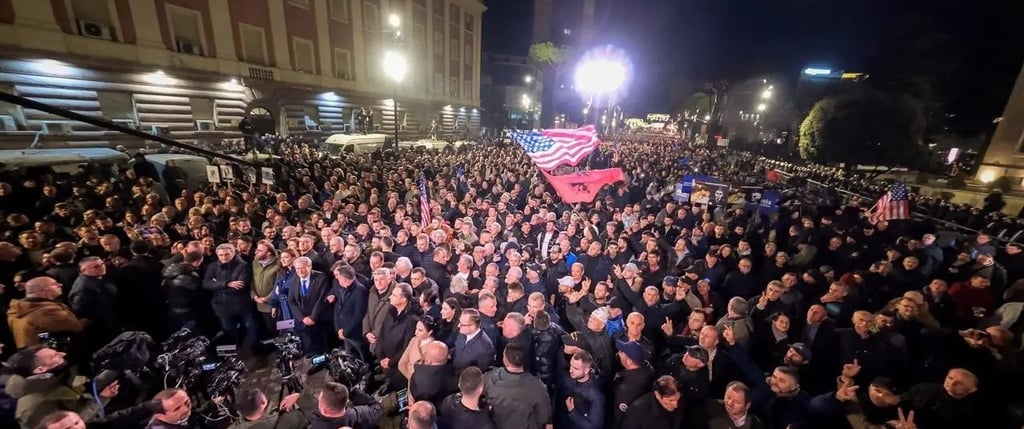
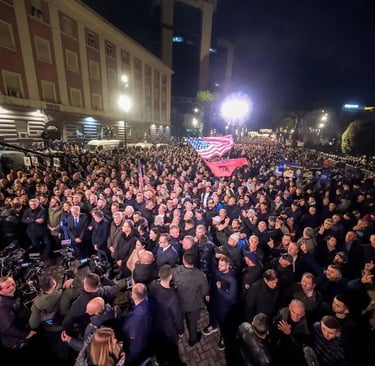
Albania’s latest national opposition protest in Tirana ended in violent clashes between demonstrators and police, revealing rising anger against Prime Minister Edi Rama’s government and a broader crisis of political legitimacy (legjitimitet). Tens of thousands of protesters confronted security forces, using Molotov cocktails, fireworks, flares, and other devices, while police responded with tear gas and water cannons.
The clashes spread across key government locations, including the Prime Minister’s Office, municipal buildings, ministries, and the headquarters of the ruling Socialist Party. Democratic Party leader Sali Berisha was reportedly injured during the police intervention, highlighting the escalating confrontation (përballje) between opposition forces and authorities.
The opposition states that the protest was driven by deeper concerns beyond immediate grievances. Its primary demands include the resignation of the government and the formation of a technical caretaker administration to oversee new elections. The Democratic Party accuses Rama of creating a centralized system of rule resembling a “narco-state,” where political power, corruption networks, and criminal interests are closely linked, reflecting systemic consolidation (konsolidim) of authority.
At the core of these claims is the allegation that Rama secured a fourth term through electoral manipulation. The opposition argues that state resources were used against political rivals during the election process, undermining democratic standards. This situation raises concerns about the erosion of electoral credibility (besueshmëri) in the country.
The political context further intensifies the crisis. Shortly after beginning his fourth term, Rama initiated major government reshuffles, dismissing senior officials amid corruption investigations. A key controversy involved parliament’s refusal to lift the immunity of a high-ranking official, preventing possible arrest and fueling accusations of political protection (mbrojtje).
These developments have contributed to perceptions of instability within the government. Critics interpret the extensive reshuffle, which replaced more than half of the cabinet, as a sign of internal divisions and an attempt to manage political fallout rather than implement meaningful reform, indicating institutional fragility (brishtësi).
The opposition links the crisis to a broader pattern of corruption scandals involving senior officials. Numerous figures have been investigated, prosecuted, or convicted, reinforcing claims that the boundaries between political leadership, economic elites, and organized crime have become blurred, illustrating deep-rooted corruption (korrupsion).
Critics also argue that illicit economic activities, including drug trafficking, are connected to the construction sector, which they describe as a channel for laundering illegal funds. This reinforces concerns about systemic interdependence (ndërvarësi) between political and criminal structures.
These internal challenges are affecting Albania’s European integration ambitions. According to opposition and independent observers, the use of parliamentary immunity to block investigations has raised concerns within the European Union, signaling potential obstacles to further integration (integrim).
The domestic consequences are also significant. Large-scale emigration and widespread dissatisfaction among young people point to declining public confidence in the country’s future, reflecting broader social discontent (pakënaqësi).
Following the clashes, Sali Berisha praised the protesters and intensified his rhetoric, framing the situation as a decisive political struggle. He warned that continued pressure would lead to major political change, emphasizing growing opposition mobilization (mobilizim).
Berisha also accused the ruling elite of exploiting public resources for personal gain, arguing that corruption and misuse of power are at the heart of the crisis. He stated that those responsible would ultimately face consequences, underscoring demands for political accountability (llogaridhënie).
The symbolic timing of the protest added further significance. Held on March 22, the anniversary of Albania’s first pluralist elections in 1992, the demonstration was intended to evoke a broader struggle for democracy and political pluralism, reinforcing its historical significance (rëndësi).
The Democratic Party of Sali Berisha during a protest in Tirana, Albania.
Send us your suggestions to: pr@albanian-institute.com
Come visit Albania!
© Copyright 2026 Albanian Institute
Learn the official language of Albania and Kosovo in 30 days thanks to our complete Grammar, Vocabulary and Culture courses. Start speaking Albanian today!